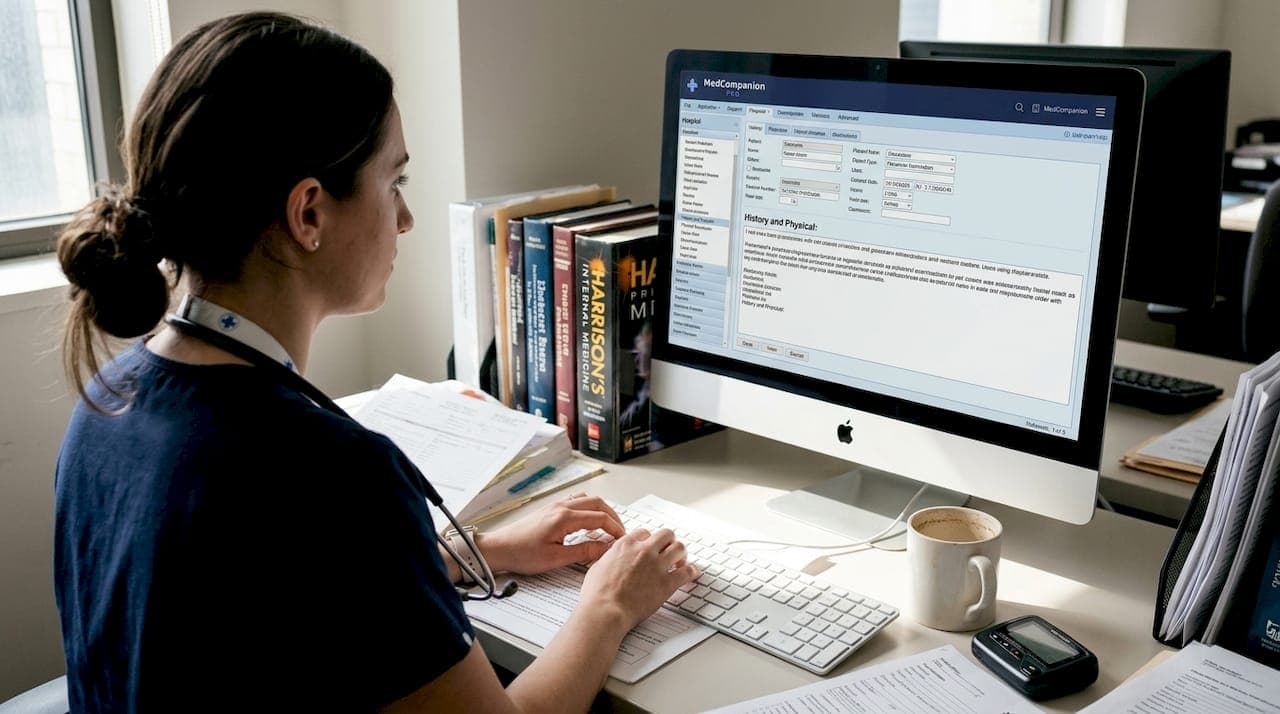
Medical documentation is both foundational and challenging for students and interns learning clinical practice. Poor documentation leads to miscommunication, medical errors, and malpractice risks, while effective notes improve patient outcomes and streamline care. Practical examples show you exactly how to structure clear, accurate records that meet professional standards. This article presents concrete documentation examples, evaluation criteria, and proven strategies to help you build confidence and efficiency in your clinical rotations. You'll learn to avoid common pitfalls and adopt methods that enhance both your learning and patient care quality.
Table of Contents
- Key takeaways
- Criteria to evaluate medical documentation examples
- Examples of common documentation types with best practices
- Head-to-head comparison of documentation methods and tools
- Situational recommendations for choosing and personalizing documentation examples
- How MedCompanion Pro helps you master medical documentation
- FAQ
Key Takeaways
| Point | Details |
|---|---|
| Five Cs framework | Evaluate documentation using the five Cs to ensure notes are clear complete concise correct and current. |
| Timely entries | Document within 24 hours of encounters to protect legal credibility and keep information current. |
| Avoid copy paste | Do not propagate errors by copying previous notes and ensure each entry reflects current clinical reasoning. |
| Patient centered language | Use patient centered language and objective data to respect individuals and reduce bias in documentation. |
Criteria to evaluate medical documentation examples
When you encounter documentation templates or sample notes, assess them using the 5 Cs framework: Clear, Complete, Concise, Correct, and Current. Clear notes use plain language that any healthcare provider can understand without ambiguity. Complete documentation includes all relevant clinical information, from chief complaint through assessment and plan, without gaps that force readers to guess. Concise writing delivers essential information efficiently, avoiding redundant phrases or unnecessary detail that creates note bloat.
Correct documentation means accurate data entry, proper chart selection, and timely recording to prevent medical errors. Current notes reflect the patient's present status, updated promptly after encounters. Best practices emphasize objectivity, clinical reasoning, and avoiding copy-paste habits that propagate errors across multiple entries. Patient-centered language respects individuals by using their own words for subjective data and avoiding stigmatizing terms.
Timeliness matters significantly for legal protection. Late entries raise questions about accuracy and can undermine your credibility if a case goes to litigation. Document within 24 hours of patient encounters whenever possible. Include your clinical reasoning process, not just observations and orders, so colleagues understand your thought process. This transparency improves care continuity and demonstrates your competence.
Pro Tip: Review your notes as if you're the next provider on the case. Can you understand the patient's story, current status, and plan without additional context? If not, add clarifying details before finalizing.
Modern AI clinical assistant features can help maintain these standards by structuring your documentation and flagging incomplete sections. However, you remain responsible for verifying accuracy and adding clinical judgment that algorithms cannot replicate. Use technology as a scaffold, not a replacement for critical thinking.
Examples of common documentation types with best practices
History and physical exam notes form the foundation of inpatient documentation. A strong H&P includes the chief complaint in the patient's own words, a chronological history of present illness, relevant past medical and social history, a systematic physical examination, and your assessment with differential diagnosis. Start with identifying information: age, sex, presenting problem. Build the HPI by addressing onset, location, duration, character, aggravating and relieving factors, timing, and severity. Document pertinent positives and negatives that support or rule out diagnoses.
Progress notes provide focused daily updates during hospital stays or clinic follow-ups. Use a problem-based approach with brief subjective reports, objective vital signs and exam findings, your assessment of each problem's status, and the plan moving forward. Avoid copying yesterday's note verbatim. Instead, highlight what changed overnight or since the last visit. This approach prevents copy-paste inaccuracies that propagate errors and obscure the patient's actual trajectory.
Discharge summaries synthesize the entire hospital course into a concise narrative. Include admission diagnosis, hospital course with key events and treatments, discharge diagnosis, condition at discharge, medications, follow-up appointments, and patient education provided. Keep it brief enough that outpatient providers can quickly grasp what happened and what needs monitoring. Minimum documentation elements improve note quality when you're learning, so use institutional templates as guides.
Pro Tip: Quote patients directly for subjective complaints. Write "Patient reports 'crushing chest pain that feels like an elephant sitting on me'" rather than "Patient has severe chest pain." Direct quotes capture nuance and protect against misinterpretation.
Common errors to avoid:
- Missing critical information like allergies or current medications
- Documenting in the wrong patient's chart
- Using judgmental language like "difficult patient" or "drug seeker"
- Delayed entries without clear timestamps
- Drop-down menu selections that don't match the actual clinical picture
Structure your examples of clinical notes around these principles, and you'll develop habits that serve you throughout your career. Practice writing notes immediately after seeing patients while details remain fresh. This discipline improves accuracy and reduces the cognitive burden of remembering multiple encounters.
Head-to-head comparison of documentation methods and tools
Traditional handwritten or typed notes offer complete control but carry significant time costs and error risks. You manually structure each section, type or write every word, and review for completeness without automated prompts. This method works well when you have ample time and want to practice comprehensive documentation skills. However, it's prone to note bloat when you copy forward large blocks of unchanged information, creating records that obscure current findings. Delayed documentation becomes more likely when notes take 15 minutes or more per patient.
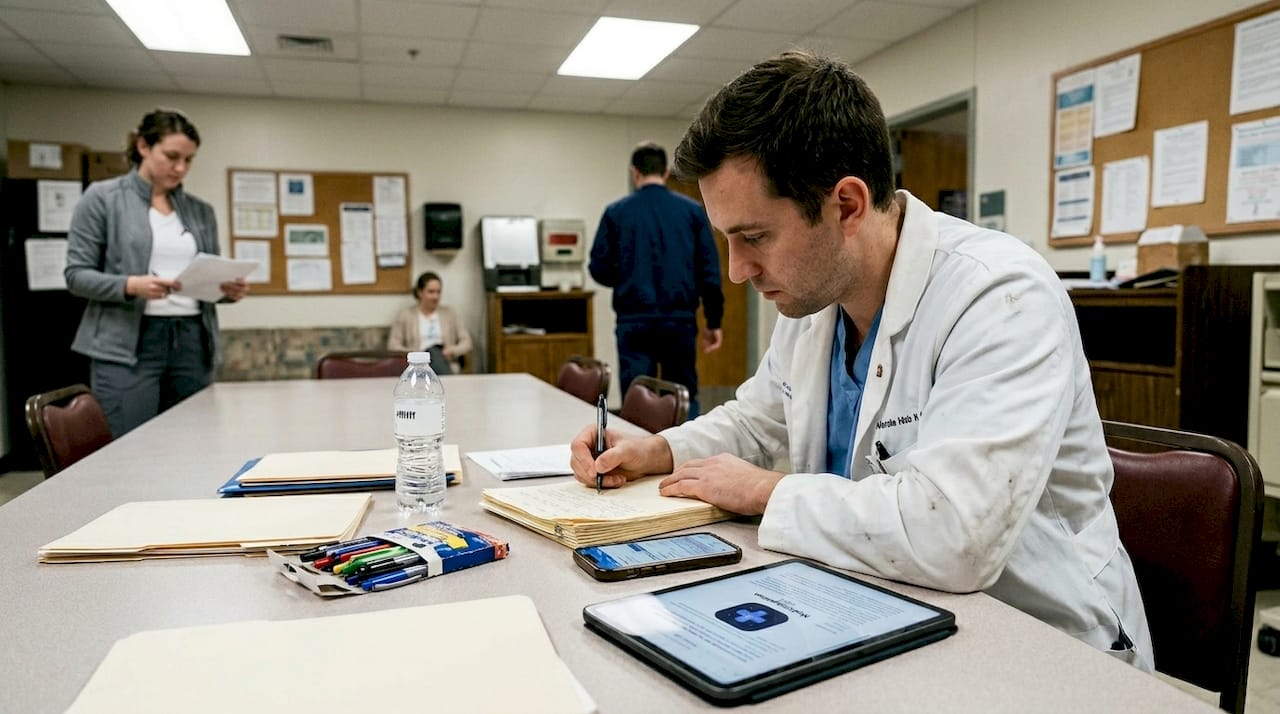
AI-assisted documentation tools reduce note creation time to 40 seconds while maintaining resident-level quality, fundamentally changing the efficiency equation. These systems use speech recognition or structured data entry to generate formatted notes that include all required elements. They prompt you for missing information, apply consistent formatting, and integrate with electronic health records. The time savings allow more patient interaction and learning opportunities during rounds.
| Feature | Traditional notes | AI-assisted tools |
|---|---|---|
| Time per note | 10-15 minutes | 40 seconds to 2 minutes |
| Standardization | Variable by user | Consistent structure |
| Completeness prompts | Manual checklist | Automated reminders |
| Error prevention | Relies on user vigilance | Flags missing elements |
| Learning curve | Familiar but slow | Initial setup, then faster |
| Clinical reasoning | Fully manual | Requires review and addition |
AI tools require supervision because they can generate plausible but incorrect information if you don't verify details. Always review AI-generated content for accuracy, add your clinical reasoning, and ensure the note reflects your actual assessment. The technology excels at formatting and completeness but cannot replace your medical judgment. Think of it as an efficient scribe that needs your expertise to produce quality documentation.
Pro Tip: Use AI tools for routine sections like review of systems or physical exam templates, then focus your time on crafting thoughtful assessments and plans. This hybrid approach maximizes efficiency while preserving the critical thinking that distinguishes excellent clinicians.
Choose your AI documentation comparison based on your institution's systems, your personal workflow preferences, and your learning goals. Early in training, writing some notes manually helps you internalize documentation structure. As you gain competence, AI assistance lets you manage larger patient volumes without sacrificing quality.
Situational recommendations for choosing and personalizing documentation examples
Your documentation approach should match your clinical context, training level, and specialty focus. Inpatient rotations demand comprehensive daily progress notes that track multiple problems, while outpatient clinic visits need focused notes addressing specific complaints. Assess each situation's documentation purpose: Is this for care continuity, billing justification, quality metrics, or legal protection? Understanding the goal helps you include relevant details without excess.
Prerounding notes optimize efficiency during morning rounds. Create a brief template with overnight events, current vitals, pertinent labs, and your assessment for each patient. This working document helps you present concisely to your team, then you expand it into the formal progress note afterward. Many successful residents use this two-stage approach to balance thoroughness with time constraints.
Apply patient-centered language consistently across all documentation types. When addressing sensitive topics like substance use or behavioral health, use objective terms without judgment. Write "Patient reports using cocaine twice weekly" rather than "Patient admits to cocaine abuse." The word "admits" implies wrongdoing, while "reports" remains neutral. Similarly, "Patient with opioid use disorder" is more respectful than "known drug user."
Personalize templates to your specialty and style:
- Start with your institution's standard template as a foundation
- Add prompts for information you frequently forget to include
- Remove sections irrelevant to your specialty
- Insert shortcuts for phrases you use repeatedly
- Test your template with real patients and refine based on gaps
Incorporate AI tools appropriately for your training stage. Physicians spend disproportionate time on documentation, and AI can reduce this burden substantially. However, early learners benefit from manual documentation practice to develop clinical reasoning patterns. Consider using AI for routine elements while writing critical sections like assessment and plan yourself until these skills become automatic.
Your documentation style will evolve as you progress from student to intern to resident. Embrace this growth by regularly reviewing your notes, seeking feedback from attendings, and studying examples from experienced clinicians you admire. The goal is developing a personal approach that's efficient, accurate, and genuinely helpful to everyone involved in patient care. Adapt your methods as you encounter new clinical scenarios and personalized documentation tips that match your workflow.
How MedCompanion Pro helps you master medical documentation
MedCompanion Pro streamlines your documentation workflow with AI-powered tools designed specifically for medical students and interns. The platform generates structured clinical notes in seconds, incorporating guided anamnesis and real-time clinical reasoning support that ensures your documentation meets professional standards. You maintain control over every entry while benefiting from automated formatting, completeness checks, and differential diagnosis suggestions that enhance your learning.
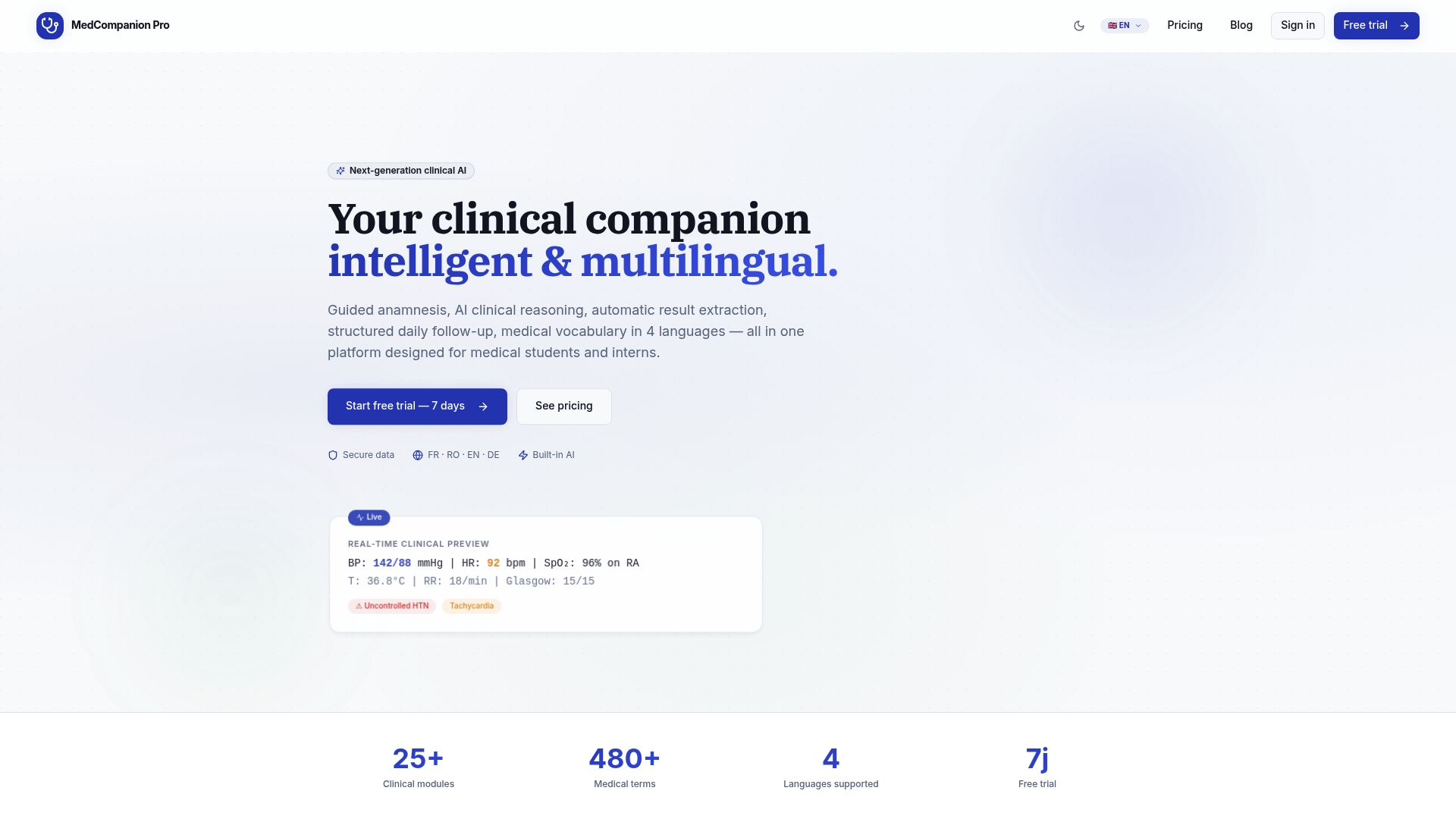
The multilingual interface supports French, Romanian, English, and German, making it valuable for international rotations and diverse patient populations. Automatic transcription captures patient encounters accurately, then transforms them into polished notes ready for your review. Export capabilities in PDF and DOCX formats integrate seamlessly with most electronic health record systems. By reducing documentation time, the MedCompanion Pro AI clinical assistant lets you focus more energy on patient interaction and clinical skill development.
GDPR compliance and end-to-end encryption protect patient privacy while you work. The platform includes case simulations and quizzes that reinforce documentation best practices in a risk-free environment. Whether you're managing complex inpatient cases or busy outpatient clinics, these AI assistant app features adapt to your needs and grow with your expertise throughout your training journey.
FAQ
What are some common errors to avoid in medical documentation?
The most frequent documentation mistakes include missing critical information, copy-paste inaccuracies, documenting in the wrong patient chart, delayed entries, and incorrect data input. These errors create serious malpractice risks and compromise patient safety. Prevent them by double-checking patient identifiers before documenting, avoiding copy-forward habits that propagate outdated information, and completing notes within 24 hours of encounters. Use institutional checklists to verify you've included all required elements like allergies, medications, and vital signs.
How can AI tools improve my medical documentation?
AI tools reduce documentation time from 14.9 minutes to approximately 40 seconds while maintaining quality comparable to resident-written notes. They standardize formatting, prompt for missing information, and generate structured content from your input. However, you must review AI-generated notes carefully to catch potential inaccuracies and add your clinical reasoning. The technology works best as an efficiency multiplier that handles routine elements while you focus on complex assessment and planning.
What is patient-centered documentation and why does it matter?
Patient-centered documentation uses objective language, incorporates direct patient quotes for subjective data, and avoids judgmental terminology that could stigmatize individuals. This approach respects patient dignity, reduces bias in medical records, and improves care quality by focusing on facts rather than assumptions. Write "Patient reports feeling anxious about surgery" instead of "Patient is overly anxious." The difference seems small but significantly impacts how other providers perceive and treat the patient.
How should I structure a history and physical exam note?
Start with patient demographics and chief complaint, then build a chronological history of present illness addressing timing, quality, severity, and modifying factors. Include relevant past medical history, medications, allergies, social history, and family history. Document a systematic physical examination organized by body systems. Conclude with your assessment listing differential diagnoses and a detailed plan for each problem. Use clear headings and concise language that any healthcare provider can follow without confusion.
What documentation approach works best for busy clinical rotations?
Create prerounding templates with spaces for overnight events, vital signs, key lab values, and brief assessments for each patient. Use these working notes during morning rounds, then expand them into formal progress notes afterward. Leverage AI tools for routine sections while personally crafting assessments and plans. Document immediately after patient encounters when details are fresh. This hybrid approach balances thoroughness with time efficiency, letting you manage typical intern workloads without sacrificing documentation quality or learning opportunities.