
Medical students and interns face a steep learning curve during clinical rotations, often struggling with inconsistent methods and overwhelming patient loads. Research shows that trainees without standardized frameworks miss critical examination steps 40% more often than those using structured approaches. Structured patient management transforms this chaos into clarity by providing proven frameworks that enhance clinical competency, improve patient outcomes, and reduce training stress. This guide explores evidence-based strategies, practical implementation tips, and how modern tools support your journey from confused novice to confident clinician.
Table of Contents
- Key takeaways
- Understanding structured patient management frameworks
- Evidence of improved clinical skills through structured approaches
- Practical strategies and expert tips for implementing structured patient management
- Overcoming challenges in clinical training through structured supervision and orientation
- Enhance your clinical training with MedCompanion Pro
- FAQ
Key Takeaways
| Point | Details |
|---|---|
| Standardized frameworks | Structured patient management frameworks like SNAPPS, checklists, and OSCE protocols improve clinical competency and diagnostic reasoning. |
| Checklists boost safety | Clinical checklists break complex tasks into repeatable steps, reducing missed exam components and preventing procedural errors. |
| Team based learning | Collaborative learning approaches enhance clinical reasoning and shared decision making during patient care. |
| Orientation reduces ambiguity | Structured onboarding clarifies roles and alleviates workload stress for learners during rotations. |
Understanding structured patient management frameworks
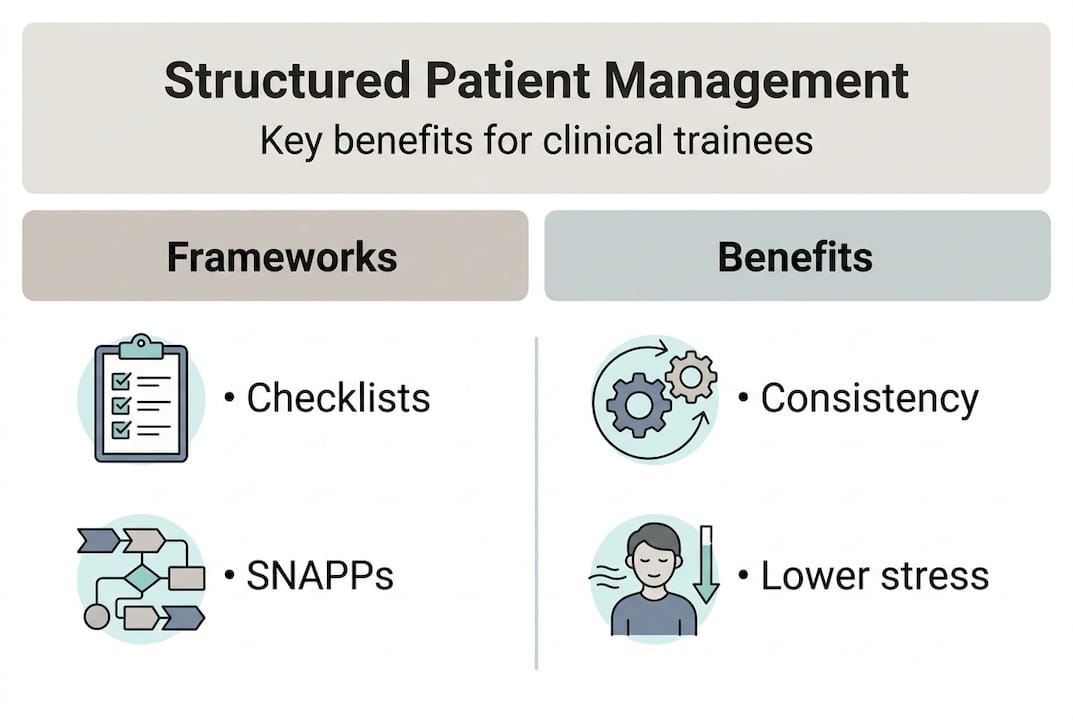
Structured patient management uses frameworks like SNAPPS, checklists, and OSCE protocols to standardize history-taking, physical exams, differential diagnosis, and management planning. These systematic approaches replace the haphazard learning many students experience with clear, repeatable processes that build competence efficiently.
The SNAPPS method guides clinical presentations through six steps: Summarize history and findings, Narrow differential diagnosis, Analyze comparisons, Probe preceptor about uncertainties, Plan management, and Select case-related issues for self-study. This framework transforms rambling case presentations into focused clinical discussions that demonstrate your reasoning process clearly. Your attending can pinpoint knowledge gaps and provide targeted feedback rather than guessing where you need help.
Clinical checklists break complex tasks into manageable components. A head-to-toe examination checklist ensures you inspect every body system systematically, preventing the common mistake of focusing only on the presenting complaint while missing important comorbidities. These tools work particularly well for procedures like lumbar punctures or central line placements, where missing a single sterile technique step creates serious complications.
OSCE protocols prepare you for both exams and real clinical encounters by establishing time-boxed stations that test specific skills. Practicing with these structured scenarios trains you to gather essential information efficiently, a skill that translates directly to busy ward rounds where you have limited time per patient. The AI clinical assistant for medical students integrates these frameworks into daily workflow, providing digital checklists and guided protocols that adapt to your specialty rotation.
Key framework components include:
- Systematic history-taking templates that cover chief complaint, HPI, past medical history, medications, allergies, family history, and social history
- Physical examination sequences organized by body system with normal and abnormal findings documented
- Differential diagnosis algorithms that weight findings by sensitivity and specificity
- Management planning tools that address immediate stabilization, diagnostic workup, and definitive treatment
- Documentation standards ensuring completeness for medical-legal protection and billing accuracy
These frameworks reduce cognitive load by externalizing mental checklists. You focus mental energy on clinical reasoning rather than remembering what questions to ask next. This structured approach particularly benefits students rotating through unfamiliar specialties where knowledge gaps are largest.
Evidence of improved clinical skills through structured approaches
Empirical research consistently demonstrates that structured training significantly improves competence in physical examinations and clinical decision-making. A multi-center study tracking 240 medical students found that checklist-based training increased physical exam accuracy by 43% compared to traditional apprenticeship models. Students using structured methods identified abnormal heart sounds, lung findings, and abdominal masses with reliability approaching that of senior residents.
Team-based learning and case-based learning enhance clinical reasoning skills measurably. Research published in BMC Medical Education showed that students participating in structured collaborative learning improved test scores by an average of 18% on script concordance tests, which assess clinical reasoning in ambiguous situations. These students also reported higher confidence in managing complex patients independently during their intern year.
The benefits extend beyond individual competence to patient safety outcomes. Hospitals implementing structured handoff protocols using IPASS (Illness severity, Patient summary, Action list, Situation awareness, Synthesis by receiver) reduced medical errors by 23% and preventable adverse events by 30%. When trainees follow systematic approaches, patients receive more consistent, evidence-based care regardless of which team member conducts the assessment.
Structured methods also accelerate skill acquisition timelines. Students using clinical frameworks achieve competency milestones 2-3 months earlier than peers learning through unstructured observation alone. This efficiency matters enormously during time-limited rotations where you must master core skills quickly before moving to the next specialty.
Structured patient management transforms clinical training from a chaotic apprenticeship into a systematic skill-building process. Students gain confidence faster, make fewer errors, and develop clinical reasoning that translates across specialties. The evidence is clear: standardized frameworks work.
Key research findings supporting structured approaches:
- Checklist users complete 94% of required exam components versus 67% for non-users
- Structured clinical reasoning training improves diagnostic accuracy by 28% in complex cases
- Students with framework training demonstrate 35% better time management during clinical encounters
- Systematic documentation reduces medical-legal risk and improves care continuity between providers
These improvements persist long-term. Follow-up studies of residents who received structured training as students show they maintain superior clinical skills and teaching abilities compared to traditionally trained peers. The checklist training study and team-based learning research provide compelling evidence that these methods should become standard in medical education.
Practical strategies and expert tips for implementing structured patient management
Implementing structured patient management requires more than memorizing frameworks. You need practical workflows that integrate these tools into fast-paced clinical environments without slowing you down. Start each patient encounter with a clear mental framework: chief complaint identification, systematic history gathering, focused physical exam, differential diagnosis generation, and management planning.
Follow this step-by-step workflow for efficient patient encounters:
- Review available records before entering the room to identify key history elements and avoid redundant questioning
- Use the SNAPPS framework to organize your presentation, starting with a one-sentence summary of patient demographics and chief complaint
- Apply body system checklists during physical exams, documenting findings in real-time using structured templates
- Generate a prioritized differential diagnosis list with 3-5 possibilities ranked by likelihood and severity
- Propose an evidence-based management plan addressing immediate needs, diagnostic workup, and definitive treatment
- Safety-net by discussing red flags that would prompt reassessment and follow-up timing
Time management using ABCDE triage improves clinical efficiency dramatically. Prioritize patients by Acuity (unstable patients first), Barriers to discharge (address early in day), Complexity (tackle difficult cases when fresh), Documentation (complete notes promptly), and Everything else (routine tasks). This system ensures critical work gets done even on chaotic days when you cannot see every patient thoroughly.
Verbalizing your clinical reasoning out loud helps preceptors identify gaps in your thinking. When presenting cases, explicitly state why you included or excluded diagnoses from your differential. For example, "I considered pulmonary embolism given the acute dyspnea, but the patient has no risk factors, normal vital signs, and clear lung exam, making it less likely than anxiety-induced hyperventilation." This transparency allows supervisors to correct faulty reasoning before it becomes ingrained.
Address patient ICE (Ideas, Concerns, Expectations) systematically by asking, "What do you think might be causing your symptoms?" and "What worries you most about this problem?" These questions uncover hidden anxieties driving healthcare utilization and help you provide reassurance or education that improves satisfaction. Patients feeling heard cooperate better with treatment plans and follow-up recommendations.
Pro Tip: Avoid the checkbox mentality by integrating systems-based thinking early in training. Checklists ensure completeness, but expert clinicians recognize patterns and adjust their approach based on clinical context. After using a framework, pause to consider: "What am I missing? What doesn't fit the pattern?" This metacognitive step prevents premature closure on diagnoses and catches atypical presentations that rigid protocols might overlook.
Practical tips for making structured methods work:
- Customize templates for your specialty rotation, adding common diagnoses and exam findings specific to that service
- Practice OSCE scenarios with peers using timed stations to build speed and fluency with frameworks
- Use clinical decision support tools that prompt you through structured assessments without requiring paper checklists
- Review your documentation against standards to identify recurring gaps in history or exam components
- Seek feedback specifically on your use of frameworks, asking attendings whether your presentations demonstrate clear clinical reasoning
Use checklists for exams and MDM templates to handle complex cases efficiently. Medical decision-making templates guide you through risk stratification, diagnostic test selection based on pretest probability, and treatment choices aligned with evidence-based guidelines. These tools prevent common errors like ordering unnecessary tests or missing guideline-recommended interventions.
Overcoming challenges in clinical training through structured supervision and orientation
Medical students and interns face predictable challenges during clinical rotations: unclear role expectations, overwhelming workloads, inconsistent teaching quality, and inadequate feedback. These problems stem largely from poorly structured training environments rather than individual shortcomings. Research shows that structured orientation and supervision mitigate issues like role ambiguity and inconsistent standards, improving rotation goal achievement significantly.
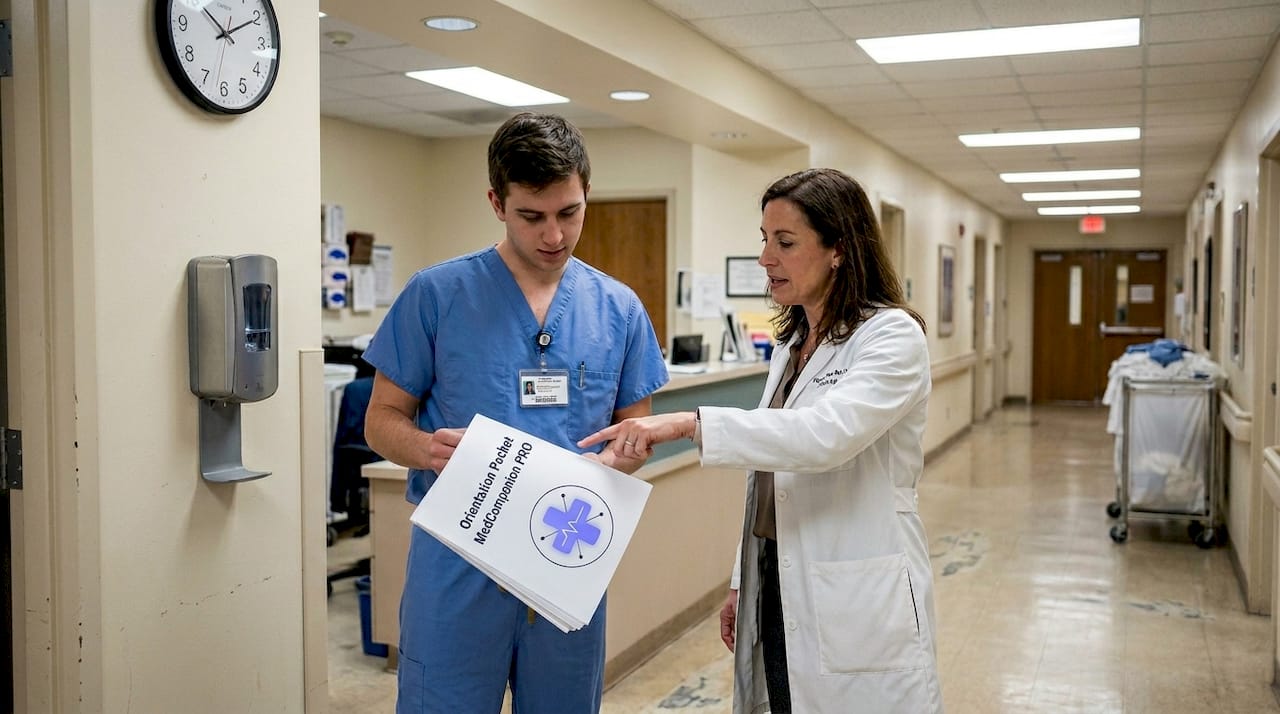
Role ambiguity creates enormous stress when you do not know what attendings expect or which tasks fall within your scope. Structured orientation sessions at rotation start should explicitly cover: your daily responsibilities, which procedures you can perform independently versus under supervision, how to escalate concerns, documentation requirements, and rotation-specific learning objectives. Providing written guidelines eliminates guesswork and reduces anxiety about whether you are meeting expectations.
High workload becomes manageable when supervisors help you prioritize effectively. Good preceptors teach triage skills explicitly, demonstrating how to identify which patients need immediate attention versus those who can wait. They also model efficient workflows like batching similar tasks, using downtime productively, and delegating appropriately to support staff. Without this guidance, students waste energy on low-yield activities while neglecting critical learning opportunities.
Inconsistent teaching quality improves dramatically with structured supervision frameworks. Regular feedback sessions using direct observation tools ensure you receive specific, actionable guidance rather than vague comments like "good job." Supervisors using structured assessment forms identify precise areas for improvement: "Your cardiac exam technique needs work on palpating the PMI" rather than "improve your physical exam skills." This specificity accelerates learning by focusing practice efforts effectively.
Ongoing supervision provides psychological safety that enhances learning. Knowing an experienced clinician reviews your assessments and management plans before implementation allows you to take appropriate risks and learn from mistakes without harming patients. This scaffolding gradually withdraws as you demonstrate competence, building independence systematically rather than throwing you into deep water prematurely.
Practical strategies for maximizing structured supervision benefits:
- Request specific feedback on one skill per shift rather than general performance comments
- Prepare questions about challenging cases before meeting with supervisors to use teaching time efficiently
- Document learning goals at rotation start and review progress weekly with your preceptor
- Seek structured clinical supervision that includes direct observation of your patient encounters, not just case discussions
- Use peer teaching to reinforce your own learning while helping colleagues master difficult concepts
Structured orientation reduces stress by clarifying expectations from day one. When you understand rotation logistics, patient care responsibilities, and evaluation criteria upfront, you focus mental energy on learning rather than navigating organizational confusion. Programs implementing comprehensive orientation report 30% reductions in trainee anxiety and corresponding improvements in clinical performance metrics.
Enhance your clinical training with MedCompanion Pro
Navigating clinical rotations becomes significantly easier when you have intelligent support systems that reinforce structured patient management principles. MedCompanion Pro serves as your AI-powered clinical companion, integrating the frameworks and checklists discussed throughout this guide into an intuitive digital platform designed specifically for medical students and interns.
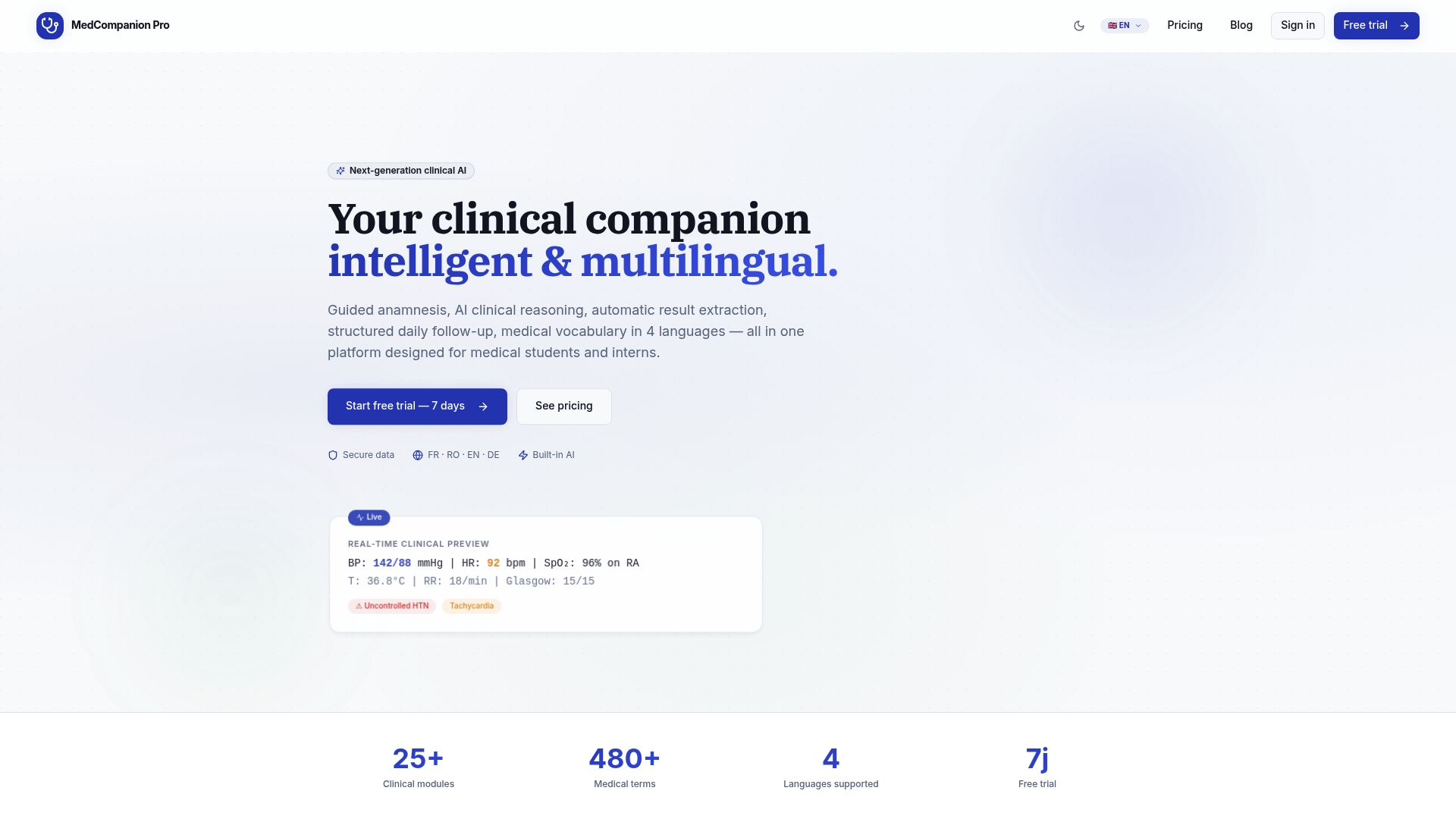
The platform guides you through systematic patient assessments using evidence-based templates for history-taking, physical examinations, and differential diagnosis generation. Real-time clinical reasoning support helps you think through complex cases methodically, while automatic documentation features save hours of charting time. Multi-language support in French, Romanian, English, and German makes it accessible for international rotations and diverse patient populations.
MedCompanion Pro AI clinical assistant transforms your smartphone into a powerful learning tool that provides case simulations, quizzes, and a comprehensive medical vocabulary encyclopedia. The platform emphasizes security through GDPR compliance and end-to-end encryption, ensuring patient data remains protected while you focus on delivering excellent care and building clinical competence efficiently.
FAQ
What is structured patient management?
Structured patient management refers to standardized clinical frameworks and protocols that guide systematic patient assessment, diagnosis, and treatment planning. These methods include tools like SNAPPS for case presentations, clinical checklists for comprehensive examinations, and OSCE protocols for time-efficient evaluations. The approach ensures trainees cover essential components consistently while building clinical reasoning skills progressively.
How do checklists improve clinical training?
Checklists ensure comprehensive examinations by prompting trainees to assess all relevant body systems and history elements, reducing missed findings by over 40%. They improve confidence by providing external structure that reduces cognitive load, allowing students to focus mental energy on interpretation rather than recall. Research demonstrates that checklist users achieve competency milestones 2-3 months faster than peers learning through unstructured observation alone.
What are common challenges in clinical training and how can they be addressed?
Trainees frequently struggle with role confusion about responsibilities, overwhelming workloads without clear prioritization guidance, and inconsistent teaching quality across rotations. Structured orientation sessions that explicitly outline expectations, daily responsibilities, and learning objectives address role ambiguity effectively. Ongoing supervision using standardized assessment tools provides specific feedback that accelerates skill development while reducing stress through appropriate scaffolding and psychological safety.
How does team-based learning enhance clinical reasoning?
Team-based learning fosters collaborative problem-solving that mirrors real clinical practice where healthcare teams manage complex patients together. Students discuss cases from multiple perspectives, challenge each other's reasoning, and defend diagnostic and treatment decisions using evidence. Research shows this approach improves script concordance test scores by 15-20% and enhances self-assessed clinical competence compared to traditional lecture-based learning methods.